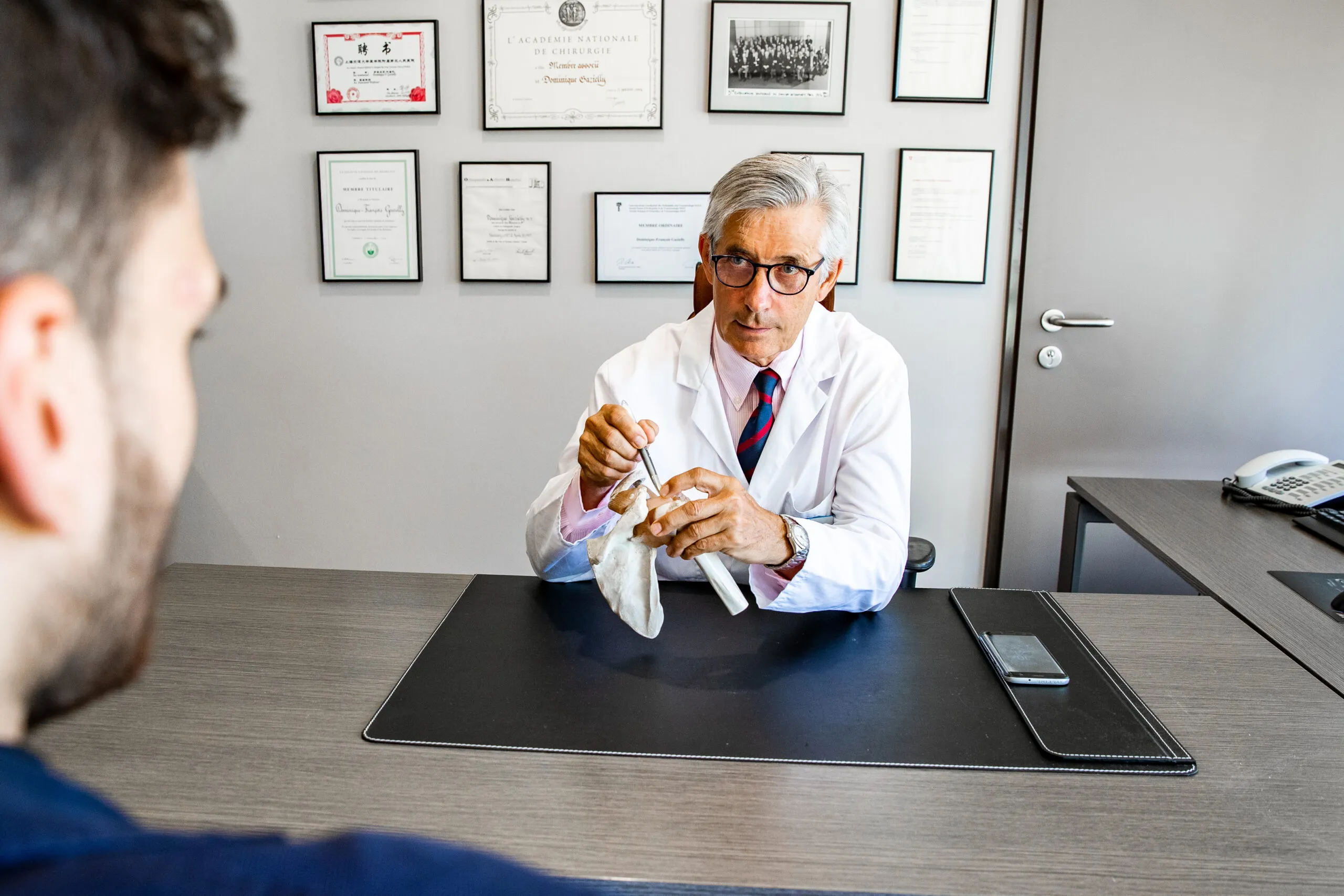
Shoulder rehabilitation
- Manual rehabilitation, based on simple exercises repeated several times a day by a motivated patient, is the essential partner of the orthopaedic surgeon specialising in the shoulder.
- We only work with physiotherapists who know our protocols and whom we can trust to care for the patients under our responsibility.
- As we will see later in the videos, we have used, for 28 years, the same simple exercises that require no machine, no special equipment, only the physiotherapist's hands, a rubber band, a stick… and the patient's motivation.
- We recommend two to three 30-minute sessions per week with the physiotherapist, plus four 10-minute sessions in the morning, midday, afternoon and evening, done by the patient alone at home. Several short daily sessions are preferable to one long daily session. "The more often you passively mobilise the shoulder, the less pain you have."
- After shoulder surgery, whether arthroscopic microsurgery or open, post-operative rehabilitation accounts for half of the final functional outcome. We see patients ourselves 15 days, 6 weeks, 3 months and 6 months after surgery.
- We never operate on a patient whose shoulder is stiff or who is unable to actively raise the arm following a fall. It is preferable to undergo pre-operative rehabilitation. "Pre-operative rehabilitation is time saved on post-operative rehabilitation."
- In our experience, effective rehabilitation can also stabilise, or even cure, 3 patients out of 4.
- A specific proprioceptive rehabilitation protocol allows us to effectively treat a painful, unstable shoulder in a context of constitutional or acquired ligamentous hyperlaxity.
- For operated patients residing outside Switzerland, we provide a "Patient Handbook", which describes step by step the exercises they will need to do alone.
The stages of functional recovery
The successive stages of functional recovery after shoulder surgery are the same regardless of the procedure performed. Only the recovery timelines vary depending on the type of intervention.
- Stage 1: Recovery of passive range of motion within 3 to 6 weeks post-operatively
- Stage 2: Recovery of active mobility within 6 weeks to 3 months post-operatively
- Stage 3: Strengthening exercises after 6 weeks or 3 months post-operatively
- Driving is permitted within a variable period, from the 6th week to the 3rd month post-operatively
- Return to work timelines vary from the 6th week to the 3rd month post-operatively, depending on whether the profession is manual or not
Warning! Functional recovery of a shoulder after surgery is not a race. The patient must respect the incompressible tissue-healing period of 6 weeks. We often say: "Everything is decided during the first 6 post-operative weeks." Any carelessness during this period (driving, computer use, repetitive movements) will lead to pain and its corollary, stiffness.
We recommend reading the Rehabilitation chapter.